Comet C/2020 F3 Neowise 2020
Also Known as: C/2020 F3 (Neowise)
Object Type: Long period comet
Comet Background: A comet is an icy, small Solar System body that warms and begins to release gases when passing close to the Sun, a process called outgassing.
This produces an extended, gravitationally unbound atmosphere or coma surrounding the nucleus, and sometimes a tail of gas and dust gas blown out from the coma.
These phenomena are due to the effects of solar radiation and the outstreaming solar wind plasma acting upon the nucleus of the comet.
Comet nuclei range from a few hundred meters to tens of kilometers across and are composed of loose collections of ice, dust, and small rocky particles.
The coma may be up to 15 times Earth's diameter, while the tail may stretch beyond one astronomical unit.
If sufficiently close and bright, a comet may be seen from Earth without the aid of a telescope and can subtend an arc of up to 30° (60 Moons) across the sky. Comets have been observed and recorded since ancient times by many cultures and religions.
Comets usually have highly eccentric elliptical orbits, and they have a wide range of orbital periods, ranging from several years to potentially several millions of years.
Short-period comets originate in the Kuiper belt or its associated scattered disc, which lie beyond the orbit of Neptune.
Long-period comets are thought to originate in the Oort cloud, a spherical cloud of icy bodies extending from outside the Kuiper belt to halfway to the nearest star.
Long-period comets are set in motion towards the Sun by gravitational perturbations from passing stars and the galactic tide.
Hyperbolic comets may pass once through the inner Solar System before being flung to interstellar space.
The appearance of a comet is called an apparition.
Discovered by: Comet Neowise was discovered by astronomers during the Neowise mission of the Wide-field Infrared Survey Explorer (WISE) space telescope on March 27,2020.
Description: NEOWISE is known for being the brightest comet in the northern hemisphere since Comet Hale–Bopp in 1997.
It was widely photographed by professional and amateur observers and was even spotted by people living near city centers and areas with light pollution.
While it was too close to the Sun to be observed at perihelion, it emerged from perihelion around magnitude 0.5 to 1, making it bright enough to be visible to the naked eye.
Under dark skies, it could be seen with the naked eye and remained visible to the naked eye throughout July 2020.
By July 30, the comet was about magnitude 5, when binoculars were required near urban areas to locate the comet.
Click Below Image(s) for Full Size:
Comet NEOWISE made its closest approach to the Sun (perihelion) on July 3, 2020, at a distance of 0.29 AU (43 million km; 27 million mi). This passage through the planetary region increases the comet's orbital period from about 4500 years to about 6800 years. Its closest approach to Earth occurred on July 23, 2020, 01:09 UT, at a distance of 0.69 AU (103 million km; 64 million mi) while located in the constellation of Ursa Major.
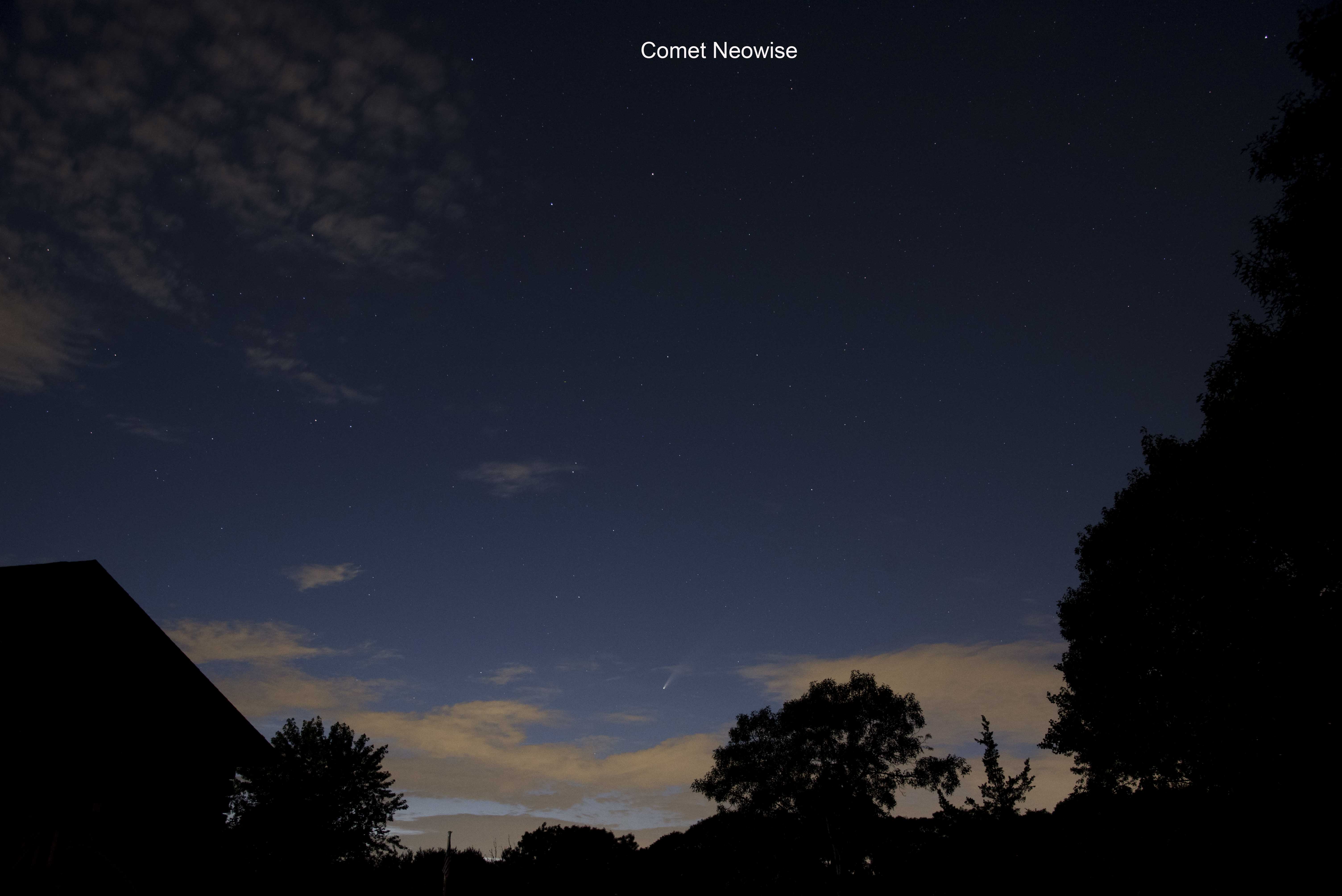
Comet Neowise

Wide Angle View: Wide field view of Comet Neowise
Imaging Details
Click to Return to Home Page